Fuel Pack

Fuel Pack

Gul Bahao has announced its latest product called fuel pack. It was presented to a World Bank Consultant Mr. Kazim Saeed at the Gul Bahao’s Research Station in Gulshan-e-Iqbal. According to Gul Bahao it is an environmentally friendly alternate fuel. A very good substitute for coal. The product has come up at a time when the world is at logger heads over the supply of oil.

The fuel pack is a block weighing 10-12 kilos of size 6x17x21 inches. It is made from clean non-toxic industrial waste and contains bits of wood, paper, cloth pieces etc. Here it may be mentioned that Gul Bahao is daily collecting about 15 tons of waste material from 200 factories of Landhi and after several attempts has been able to come up with the fuel pack. The shape of the block is the same as that of was-tic blocks (building blocks made from plastic waste) and is made in the same mould. This took several years to develop. The pack does not contain anything that may produce toxic fumes. It is portable and is covered with tinsel or aluminum foil, which gives it an aesthetic look. Another attractive aspect of this block is its relative cost effectiveness. It costs as little as Rs 20 per block. It has been tried experimentally and has given excellent results. A business group in Karachi has volunteered to market it
Pakistan’s first Environment Museum inaugurated by Vice Chancellor Karachi University

Pakistan’s first Environment Museum inaugurated by Vice Chancellor Karachi University

People of Karachi traveling on the NIPA bridge witnessed a rare spectacle on Environment Day. A 20′ x 40′ beautifully constructed prefabricated “Chandi Ghar” glittering and shimmering in the blazing sun. A twenty member group of the alumni of Karachi University called Unikarians headed by the Vice chancellor of Karachi University had come to inaugurate Pakistan’s first Environment Museum.

Nargis latif the chairperson of Gul Bahao showed the group around an impressive display of recycled products invented by the organization. “There are lots of people making handicrafts from waste material. But Gul Bahao’s mission is to recycle in order to make commercially viable products”, she revealed.

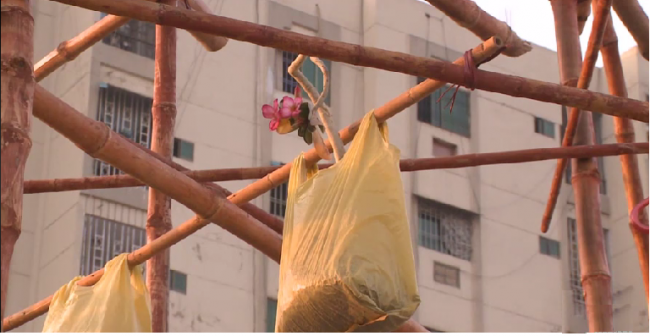
At the entrance to the museum was the Gardens in the Air. The visitors were amazed to know that spinach,onions, cattle feed etc was being grown 20 -30 ft. Above the air in small shoppers containing manure made from municipal waste. Another section of the museum showed the latest venture of the organization. Waterproof tarpaulins made from shoppers and wrappers (packing material). Nargis said a good deal of waste generated from factories is clean waste which may be considered virgin material and treated like any other raw material.

A huge water reservoir was the Centre of attraction. Again the guests were fascinated to learn that the chandi blocks were converted into swimming pools as well as household furniture . The inside of the chandi hall was full of sofas, a master bed and tables tastefully arranged.

In his inaugural speech Vice Chancellor lauded the services of Nargis Latif and said that he has been following Gul Bahao’s activities for quite some time.

Horticulture in air

Horticulture in air

According to its spokesman Mohammad Hannan the objective behind this project is to recycle organic waste which in a city like Karachi accounts for 50% of its total waste. The gardens in the air present a rare spectacle. They are basically two wooden scaffolding carrying a wide assortment of plants, flowering plants, onions, spinach etc.

When the camera man wanted to film the plants they were brought down by means of a huge nailed bamboo sticks. On close quarters it was found that the plants instead of pots had plastic bags as containers. The plastic bags were attached to the scaffolding by means of an intricate use of rope knotting.

Further elaborating Mohammad Hannan the spokesman explained that the “Gardens in the Air” is in line with Gul Bahao’s philosophy of “Forging a nexus between environment and economy” and that these plants at some stage will be grown for the market. Pointing to Gul Bahao’s manifesto he said the “City Farm” was visualized years ago, At this point Gul Bahao’s Nargis Latif told the television crew that her organization had been working on industrial waste especially plastic waste for a long time but organic waste was neglected for a long time.

Further elaborating Mohammad Hannan said that organic waste has been collected from road sites, garbage dumps ,cattle farms and mixed up in a small land fill at Gul Bahao’s research centre in Gul shan-e-Iqbal. There it is converted into organic fertilizer which is put into polythene bags into which plants are grown. These plants are then put up on the scaffolds giving the impression of multitier fields similar to multistoried houses.

However since the last one year or so her organization has restarted research work on organic waste once again. Pointing to the 5×5 by 30 ft high scaffolding she asked the television crew can you imagine growing 50 different kinds of full grown plants in such a small area and that to along the main road of one of the biggest metropolises of the world She shocked the anchor person by predicting that “By the grace of God we will soon be having wheat and barley growing in the skies of Karachi.”

Gul Bahao’s Fuel Pack

In a press statement Gul Bahao has said that the “Fuel Pack” that it has made from waste material could help to solve the acute problem of electricity, the city is facing. According to Gul Bahao it is an environmentally friendly alternate fuel, a good substitute for oil; because it does not give out any toxic fumes, at the same time is cheap and easily available. It can be easily used as fuel for thermal power stations.

Giving the back ground of the “Fuel Pack” Gul Bahao has said that in 2006 it was collecting different kinds of industrial waste during the months of February to April from 80 factories of the EPZA by means of 8 trucks on daily basis and it has been conducting experiments on them ever since. Techniques used were those that have been developed by Gul Bahao for making its famous “Wastic Blocks”. The “Fuel Pack” is a block weighing ten to twelve kilo of size 6 inches by 17 inches by 21 inches. It consists of clean non toxic industrial waste like bits of wood, paper, cloth etc. which are not mixed up with putrefying waste. A protective covering of aluminum foil which is fire resistant is put on the blocks which also give it an aesthetic look.

The blocks have been used as fuel in different places which gave extremely good results. One well known industrial company even volunteered to market it. Considering the grave power situation, Gul Bahao has asked the Government to consider its “Fuel Pack” as fuel for thermal power stations. The advantage of this alternative fuel is its easy availability as well as its low cost.

Here it may be mentioned that Gul Bahao has been experimenting with waste material for the last thirteen years and so far has spent 4 crore of rupees. It has had as many as 80 people working in a single day. It has also succeeded in establishing Pakistan’s first Research Center for waste management.