Sponsorship of “Karachi’s gift to the world”

Gul Bahao Letter Head

Dear sir

Gul Bahao is planning to take out a publication in the month of August which will be listing, photographing and explaining the various innovations developed by us. These are briefly  :

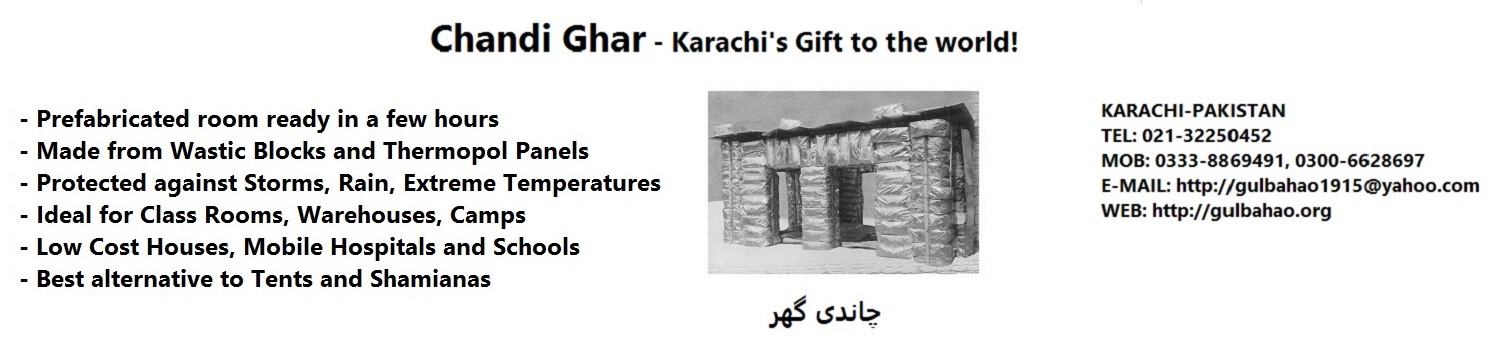
  1. Chandi Technology – modular blocks which  are inter convertible into a two storied house, light weight furniture ( tables, chairs, beds etc ), water pond, reservoirs etc.
  2. Fuel packs for producing cheap electricity
  3. Safai/Kamai bank ( a futuristic  bank )  ……..   and many more

The purpose of the book is  manifold. To work on:

  1. Disaster management
  2. Waste management and conserving the environment in order to prevent extreme climatic conditions of temperatures as well as rainfall, flooding etc.
  3. To provide our youth and entrepeneurs with “unlimited opportunities” to make profits from minimum  investment.

These innovations have received international recognition from the following:

  1. Italian, French , Indian  and South Korean publications
  2. CNN,Voice of America,BBC, Zee t.v etc
  3. Clinton foundation, Ashoka Foundation
  4. UNDP, ILO,WSCC, Supreme court of India
  5. German nationals (including their consul general)
  6. Representative of United Nations
  7. Saarc conference held at Kathmandu.

Why are the innovations a Gift from Karachi to the World?. It may be remembered that:

  1. Karachi is one of the largest metropolises of the world
  2. It has a peculiar geography ( desert like conditions with a relatively moderate climate)
  3. It is highly urbanized and modernized. Hundreds of educated Karachites (  lecturers, professors, professionals like architects, engineers, business men, philanthropists etc) have donated in cash or kind (recyclable material which fetch a good price in the market ). Research demands money and this is where the finances came from. Secondly Karachi’s youth, especially its uneducated youth were responsible for:The physical development of the products including collection of the raw materials. The educated youth on the other hand may be credited for arranging seminars ,writing theses, and reports and media coverage. In short it has been a big movement spread over a period of 21 years and costing more than 8 crore rupees.

We  would like you to consider sponsoring this extremely valuable book according to the following rates:

  • half page -Rs.50,000 (fifty thousand)
  • quarter page -Rs.30,000(thirty thousand)
  • your organisations/institution’s name  in the list of sponsors-  Rs. 7,000 (seven thousand)

The book will be launched in the month of  August either at the Karachi press club or the Arts council

Waiting for an early reply ,

I am
Yours Sincerely
Nargis  Latif

Uncensored write up version of A-level student from Karachi Grammar School about Gul Bahao’s activities

As a child, being interested in the cleanliness of the environment, my one month internship at the Gul Bahao Research Centre during the summer of 2015 proved to be an invaluable learning experience for me, as I wish to pursue an environmental-oriented career in the near future. Despite being a small organization, the initiative which the staff takes in trying to promote re-cycling and re-using of garbage is commendable. None of this would have been possible without the guidance of the organization’s founder, Ms. Nargis Latif.

Over the past two decades, the organization has suggested numerous green solutions to keep our surroundings clean and reduce consumption of expensive resources. The organization’s most valuable contribution towards recycling of waste material is the ingenious “Chandi Technology”. The technology consists of “wastic blocks” and “panaflex panels” made out of clean, unused factory wastes such as defected labels and wrappers. Instead of burning this “valuable” garbage, unused factory waste is given a new lease of life by being sent to the Gul Bahao Research Centre to manufacture blocks and roof panels, which are further utilized to construct make-shift shelters, cheap and sturdy houses, mobile toilets, furniture and water tanks/swimming pools. The garbage is wrapped in silver foil to give the building material a distinctive appearance, as well as acting as an insulating material for shelters. The blocks are light in weight, thus making them mobile and easy to use as construction material. This feature allows rapid construction of shelters with aid of relatively less man power. The cost of constructing such structures is low enough to make it affordable for common man, thus serving as a cheap alternative to brick shelters or expensive plastic and wooden furniture. Last but not least, the Chandi blocks and panels are able to withstand all weather extremes, be it sunlight, heavy rainfall, or gusty winds. Thus, the recent Chandi Technology is a modern, eco-friendly solution to every problem.

The organization’s other initiatives include “Paaki Paani”, where tap water is filled into transparent plastic bottles and left in sunlight for a few hours. The ultraviolet rays of the Sun kill most of the bacteria present in the water within a span of 3 to 4 hours. This method is not only a cheap and efficient method to purify water, but also reuses plastic bottles which are usually thrown away. If brought into mass usage, Paaki Paani technology can help solve the global shortage of clean drinking water, thus bringing clean, germ free drinking water to the masses.

Gul Bahao’s “Choora Chaara” technology converts fruit and vegetable to compost, which can then be marketed as a cheap alternative to expensive, branded cattle feed. The organization has also invented ingenious fuel packs, each weighing ten to twelve kilograms, with dimensions 6x17x21 inches. The fuel pack is an environmental friendly alternative to fossil fuels, as they do not release toxic fumes, and at the same time, are cheap to produce and easy to transport, requiring no special transportation method unlike oil and natural gas. Non-toxic industrial wastes such as wood, cloth and bits of paper are wrapped in aluminum foil, which is slow burning, and helps to give long-lasting energy when burnt.

It is a shame that the general public does not take Gul Bahao’s eco tips as a solution to their daily problems. It is also sad to learn that the government is not funding or paying heed to any of the organization’s research programs. However, with the passage of time, I hope to see Gul Bahao’s simple, yet highly useful innovations come to use, as they not only reduce a person’s expenditure, but also aid in keeping the environment neat and clean.

Shahan D. Engineer

Press Clippings

Research Center

Fuel Pack