Gul Bahao research center inauguration by sindh assembly speaker

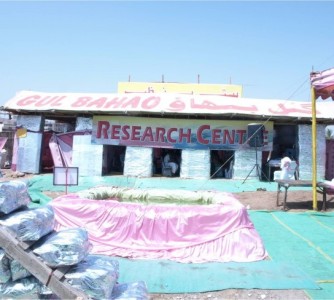
Yesterday Gul Bahao’s Research Center was formally inaugurated by the Sindh Assembly Speaker Mr. Nisar Ahmed Khoro. This is part of the Gul Bahao’s Complex located on a two thousand sq.yards plot on main Rashid Minhas Road. A crowd of more than three hundred people welcomed the Speaker on his arrival. The atmosphere was that of a mela with music blaring away and people coming in and looking at the different exhibits of the NGO. Amongst them were:

  • The FUEL PACK – block containing inflammable waste material which it was said could be a cheap substitute for running thermal power plants.
  • CHOORA CHARA – packets containing dry fodder for live stock.
  • A MOBILE TOILET for females.
  • PAKI PANI – a simple water purifying method.

However the biggest crowd puller was the CHANDI GHAR. This as well as the Hall used for the occasion were made of pre-fabricated material, innovated by Gul Bahao.

A major event of the occasion was the public meeting addressed by the leaders of the civil society. Nargis Latif pointed to the banner placed behind the dais which read “Karachi’s gift to the world”. She said we have been following the rest of the world specially the West for a long time. She said Gul Bahao for the last fifteen years tried to reverse the trend. It is only today that it has succeeded in attracting the attention of the Government. Nargis lamented that though the NGO has spent not less than four crore rupees on its research activities during the last ten years it received only Rs. 15000/- from the previous Government.

The Speaker of the Sindh Assembly Mr. Nisar Khoro described Gul Bahao’s Chandi Ghar as a “modern Juggi”. He said that a cemented house has become unaffordable for the poorest of the poor but now at least they will be able to give a dwelling safe from the elements for as little as 7-8 thousands rupees, the cost of a Chandi Ghar. The Speaker referred to Nargis Latif as a “jununi” or mad. He said only a person with deep commitment could take up the monumental task of doing what she is doing. Other speakers included Mr. Ashraf Nawaz of Pakistan Help Line, Mr. Habibuddin Junaidi, a well known leader of Pakistan Peoples Party and a number of leaders from the Seraiki Community. The Hall kept reverberating with slogans in favour of Peoples Party.
Chandi Ghar exhibition on independence day

Chandi Ghar exhibition on independence day

Gul Bahao in its press release has invited the public to see the latest model of its pre fabricated house on main Rashid Minhas Road. This updated version of the Chandi Ghar comes at a time when the nation is celebrating its 60th birthday. The innovation is remarkable in that no country in the world including the developed worlds China, USA or Europe have come up with anything like this. The structure is composed of wastic blocks and panaflex panels which are in turn made up of plastic, aluminum foil and cardboard residue. The structure is also portable. Following are the improved features of the innovation:

  1. Its modest, humble-looking structure has transformed into one of grandeur; it glitters in the light both inside and outside,
  2. The blocks are covered with silver panels which ensure the longevity of the structure,
  3. The improvement in the roof panel is its water-proof quality, since there is a single panel for the roof which ensures that water does not trickle into the room.
  4. The cost of the panel for the roof has gone down considerably, the roof 10X10 costs as little as rupees 1500, making it extremely attractive for the poor.

Recently the Rotary Club had asked Gul Bahao to come up with the shelter for the flood affected. In response Gul Bahao has put up one such structure in Clifton. It is extremely simple, comprising only of panaflex panels and bamboo sticks. The shelter costs as little as rupees 4000-6000.  These shelters are of the size 10X10, while a room complete with blocks and panels costs between 8000-15000. The shelters because of their low cost can be given to the flood affected on a massive scale. According to Gul Bahao, its research has yielded products which can be used by both the rich and the poor. Gul Bahao has appealed to architects, NGOs, politicians, the media and the Pakistani public to take up this innovation  (research on which has cost rupees 4 crore) as a product coming from Pakistan.

Gul Bahao’s research center visted by Nazims and Naib Nazims of Sindh

Gul Bahao in a statement has reported that a delegation of about thirty Nazims and Naib Nazims from all over Sindh visited its head office in Gulshan-e-Iqbal. They included people from Shikarpur, Hyderabad, Jacobabad, Tharparkar, Khairpurmirs, Jamshoro, Nausheroferoz, Badin, Dadu and Larkana.The delegation was lead by Mr Allahudin Mashori under the auspices of MTRI Pakistan (Municipal Training and Research Institute located in Clifton).

The participants were first taken on a round of the Gul Bahao camp which included the garbage collection point which is slowly being developed into what is being called the Safai Kamai bank. There after the participants were ushered into a room called Chandi Ghar, an innovation of Gul Bahao. This was used by Nargis Latif for her hour long talk. Nargis said that many people had visited Gul Bahao’s premises in the past. Among these included:

  1. German Counselor, Mr Detlef Quester.
  2. Mrs Almithra Patel from the supreme court of India.
  3. A twenty five member delegation from Quetta.
  4. Students of Architecture from Daud and N.E.D University.
  5. B.B.C, Zee T.V,Star Plus and several local channels like Aaj T.V, Indus T.V,P.T.V, Sindh T.V, ARY Digital.
  6. WWF and representatives of several other N.G.O’s

Nargis Latif told the participants that Gul Bahao is planning for the establishment of a Gul Bahao complex which will have three components. One will be the Safai Kamai bank which has been the practical and commercial aspect of Gul Bahao so far and which will be a futuristic version of Kabaris. The second component she said will be a pre-fabricated housing plant called Chandi Ghar. She related to the audience that the Chandi Ghar has been recognized as a construction company by many well known quarters.

The third important component of the complex will be a research center on waste management where all the on going research of Gul Bahao will be conserved and put on record and where research students will have access to the previous and on going projects of Gul Bahao. She said she has approached several philanthropists,bankers and well known personalities of the city of Karachi for her project. She said her campaign revolves around Karachi’s gift to the world. She said that the complex will start a service for disseminating environment intelligence throughout the world.

Nargis Latif told the participants that Gul Bahao’s work has been the linking of the environment with the economy. For several months it carried out a campaign Gold for Garbage and used to give 24 carat gold nuggets in addition to cash to the junk dealer in return for their garbage. This gave an impetus to a whole generation of junk dealers to start dealing with waste material which they previously ignored. This has also given an impetus to the local industry as more an more raw material is being made available to it which was previously being thrown into the Kachra Kundis.

Nargis Latif said that her organization has gone through several ups and downs. At its peak which has being about three times she said that between seventy to eighty people were working and up to a dozen vehicles were going to different parts of the city.

The managing trustee of Gul Bahao said that her organization not only conducts research but it also undertakes advocacy campaigns. She told them that Gul Bahao is now trying to advocate the use of industrial effluents for use in aforestation. She said that we cannot bring a clash between industrialization and the environment by going for one or the other. No doubt she said it is good to advocate environment friendly industry related to simple technology. However one should try to use recycling as a tool for minimizing the dangers accruing from large scale industry. She said that plantations should be grown along the drains carrying factory effluents. These will act as suction pumps. On the other hand the wood of these trees may be regularly cut down and sold for furniture, building purposes or even for fuel. The participants highly appreciated Nargis’s lecture and the leader of the delegation invited her to visit the federal ministry’s institute for local bodies.